
Poona Rare Metals Targets

Historic non-systematic programmes have been conducted intermittently across the Poona Area by multiple explorers from the early 1970’s until 2021. These programmes were limited, only covered discreet areas and included soil/rockchip geochemistry, ground moving loop electromagnetic surveys (MLEM), reverse circulation (RC) drilling and wide spaced aircore (AC) drilling traverses.

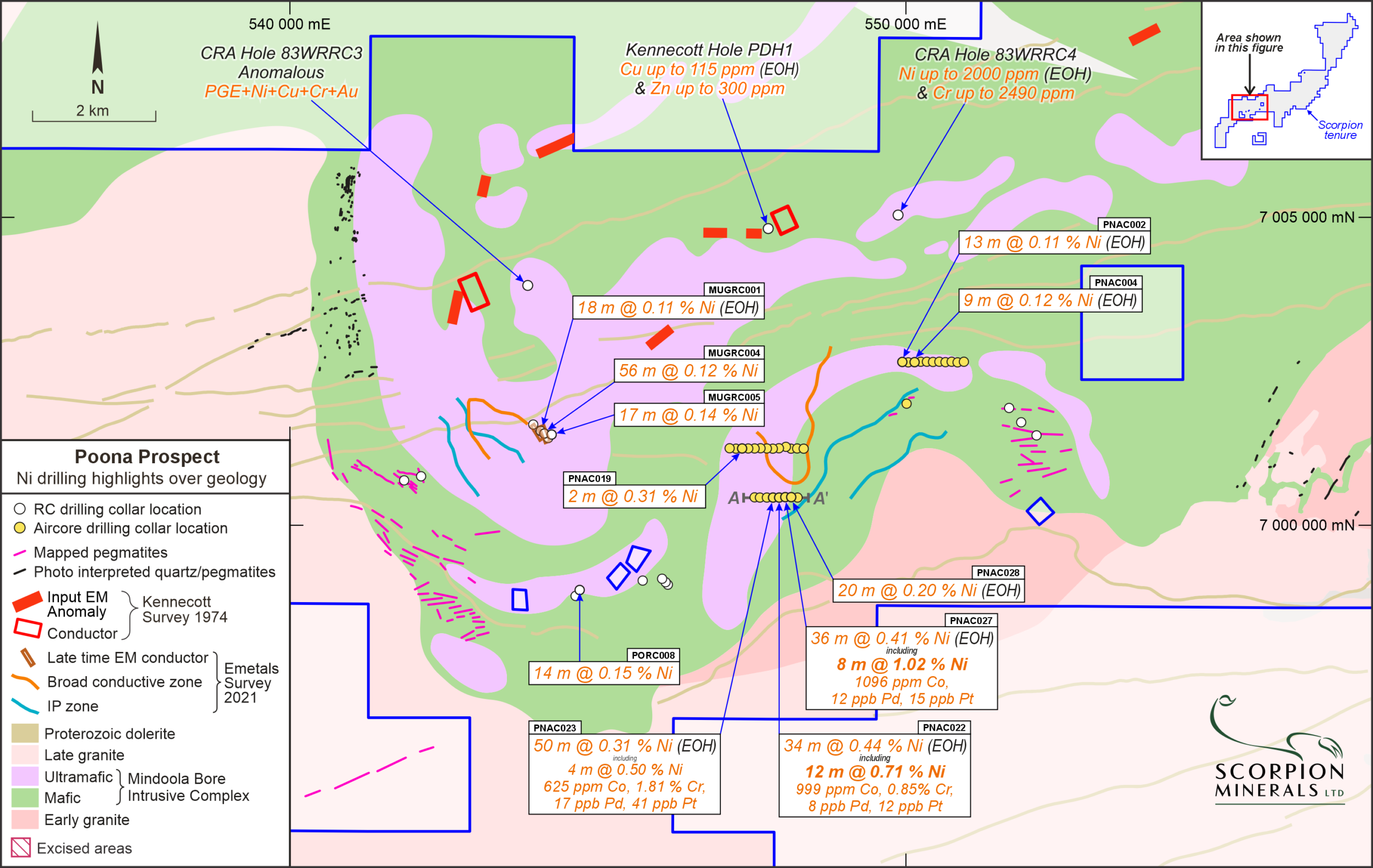
These programmes have identified significant untested mafic/ultramafic-hosted PGE-Ni-Cu targets within the Mindoolah Bore intrusive complex that correlate with EM/IP anomalies, and coincident elevated PGE and Ni geochemistry adjacent to basal or contact stratigraphic positions (For full details click here).
Historic highlights

  • Significant Ni, Co, Pd, Pt, W and Au soil anomalies associated with the interpreted Mindoolah Bore Mafic/Ultramafic Intrusive Complex
  • Wide spaced aircore drill traverses targeting magnetic highs intersected significant Ni with associated anomalous Co (max 1383 ppm) & Pd+Pt (max 58 ppb) at the Perses Prospect
  • Significant historic results from Perses include:
    – 8 m @ 1.02% Ni from 26 m
    – 12 m @ 0.71% Ni from 19 m
Significant Drilling Results - Base Metal and PGE

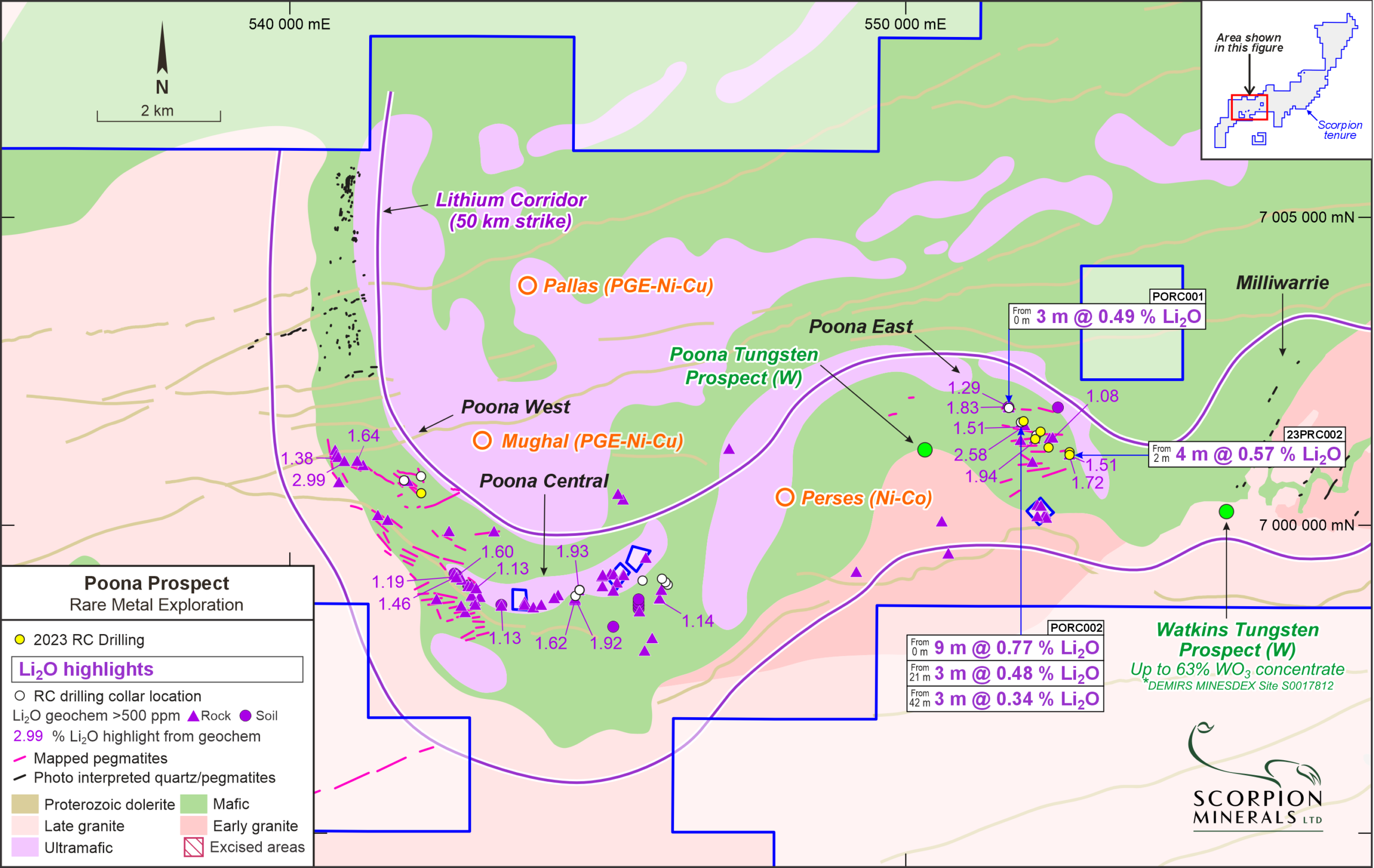
Following a detailed technical review completed Scorpion successfully extended the strike zone of significant rare metal and Lithium, Caesium, Tantalum (“LCT”) pegmatite potential within the Company’s Pharos Project to a 50km long corridor. The review has has also identified tungsten anomalies west of the historic Watkins tungsten prospect and in some case adjacent to significant gold soil anomalies.

Initial field reconnaissance including geological mapping and rock chip sampling has now been completed at Poona East and Poona West. The objectives of the campaign were to;

  1. Evaluate the effectiveness of limited historic RC drilling
  2. Obtain structural information to allow optimal planning of the initial stratigraphic RC drill test of existing targets
  3. Inspect areas of previous high lithium rock chip results
  4. Determine the potential for additional LCT pegmatites and the lateral extent of the corridor
Poona area rare metal exploration highlights over geology
Rare Metal Exploration

Mapping so far has confirmed multiple LCT pegmatites in both areas that are oriented sub parallel to the granite contact and are shallow dipping to the north (Poona East) and northeast (Poona West). Shallow dipping pegmatite orientation is a characteristic of significant LCT pegmatite systems (Click here for most recent announcement).


Poona East

  • Stratigraphic RC drilling at Poona East intersects highly fractionated LCT pegmatites
    up to 0.8% Li2O, 725 ppm Ta2O5, 222 ppm Nb2O5, 1518 ppm Cs and 7081 ppm Rb
  • Three holes intersected highly fractionated Complex LCT pegmatites that appear to
    dip steeply south
  • Total of 7 holes completed for 937 m from limited access to test stratigraphy,
    structural orientation and differentiate Complex LCT pegmatites from Simple
    pegmatites to aid future drill planning
  • Additional pegmatites confirmed by field reconnaissance 20 km east of Poona along
    the prospective granite contact south of Mt Mulcahy
  • Drilling tested historic surface sampling that returned high-grade values up to
    2.99% Li2O
  • Encouraging lithium potential identified by historic RC drilling that returned
    significant results at Poona East including:

    • 9m @ 0.77% Li2O from 0 m
    • 9m @ 0.29% Li2O from 18 m
    • 3m @ 0.49% Li2O from 0 m